
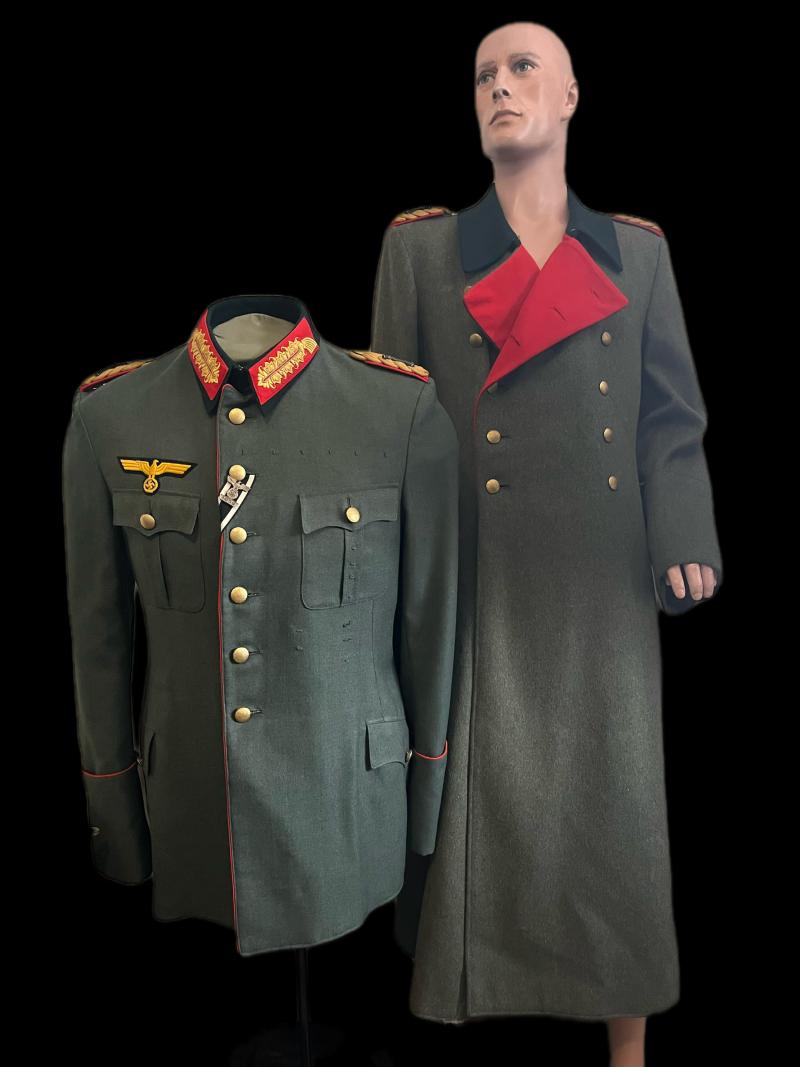
WW2 GERMAN FIELD MARSHAL TUNIC AND GREATCOAT
This set is in my personal collection.
This is a WW2 German set that belonged to Field Marshal Gunther Von Kluge, both the Tunic and Great Coat are named and dated, The tunic is a elegant 4 pocket, made of light gabardine cloth and a dark green collar which was quite common for Generals and Field Marshals preferred the old style tunic, The button placket with red piping and red lined inside and in fantastic condition and fitted with its stunning shoulder boards which are backwards sewn in which has the Silver cannons which are Silver Hallmarked 925 again not out of the norm for these to be fitted like this, stunning original collar tabs which are originally fitted, the gold embroidered Eagle and his original Spange Award to the front, also fitted and complete are all the gold buttons, the interior is also in great condition and on the inside is a later version label with its named Gunther Von Kluge and dated 1943 with the makers Wilhelm Holters, Berlin also fitted to the front left are all his loops for all his awards such as the long band clasp "1939" for the Iron Cross 1914 2 class and more, The Great coat is equally impressive which is also in fantastic condition, same again with its shoulder boards and Silver Cannons which are Silver and Silver hallmarked 925, and fitted and complete with all its gold buttons, also the interior again is very good and on the inside pocket it is again named but this time General Field Marshal V. Kluge and dated 17th Jan 1944. This set was part of a larger collection a long time ago and unfortunately was broken up over time over the years, but these two have managed to stay together.
Günther Adolf Ferdinand von Kluge (30 October 1882 – 19 August 1944) was a German Generalfeldmarschall (Field Marshal) during World War II.a Kluge held commands on the Eastern and Western Fronts, until his suicide in connection with the 20 July plot.
He commanded the 4th Army of the Wehrmacht during the invasion of Poland in 1939 and the Battle of France in 1940, earning a promotion to Generalfeldmarschall. Kluge went on to command the 4th Army in Operation Barbarossa (the invasion of the Soviet Union) and the Battle for Moscow in 1941. Amid the crisis of the Soviet counter-offensive in December 1941, Kluge was promoted to command Army Group Centre replacing Field Marshal Fedor von Bock. Several members of the German military resistance to Adolf Hitler served on his staff, including Henning von Tresckow. Kluge was aware of the plotters' activities but refused to offer his support unless Hitler was killed. His command on the Eastern Front lasted until October 1943 when Kluge was badly injured in a car accident.
Following a lengthy recuperation, Kluge was appointed OB West (Supreme Commander West) in occupied France in July 1944, after his predecessor, Field Marshal Gerd von Rundstedt, was dismissed for defeatism. Kluge's forces were unable to stop the momentum of the Allied invasion of Normandy, and he began to realise that the war in the West was lost. Although Kluge was not an active conspirator in the 20 July plot, in the aftermath of the failed coup he committed suicide on 19 August 1944, after having been recalled to Berlin for a meeting with Hitler. Kluge was replaced by Field Marshal Walter Model.
Code: 10053